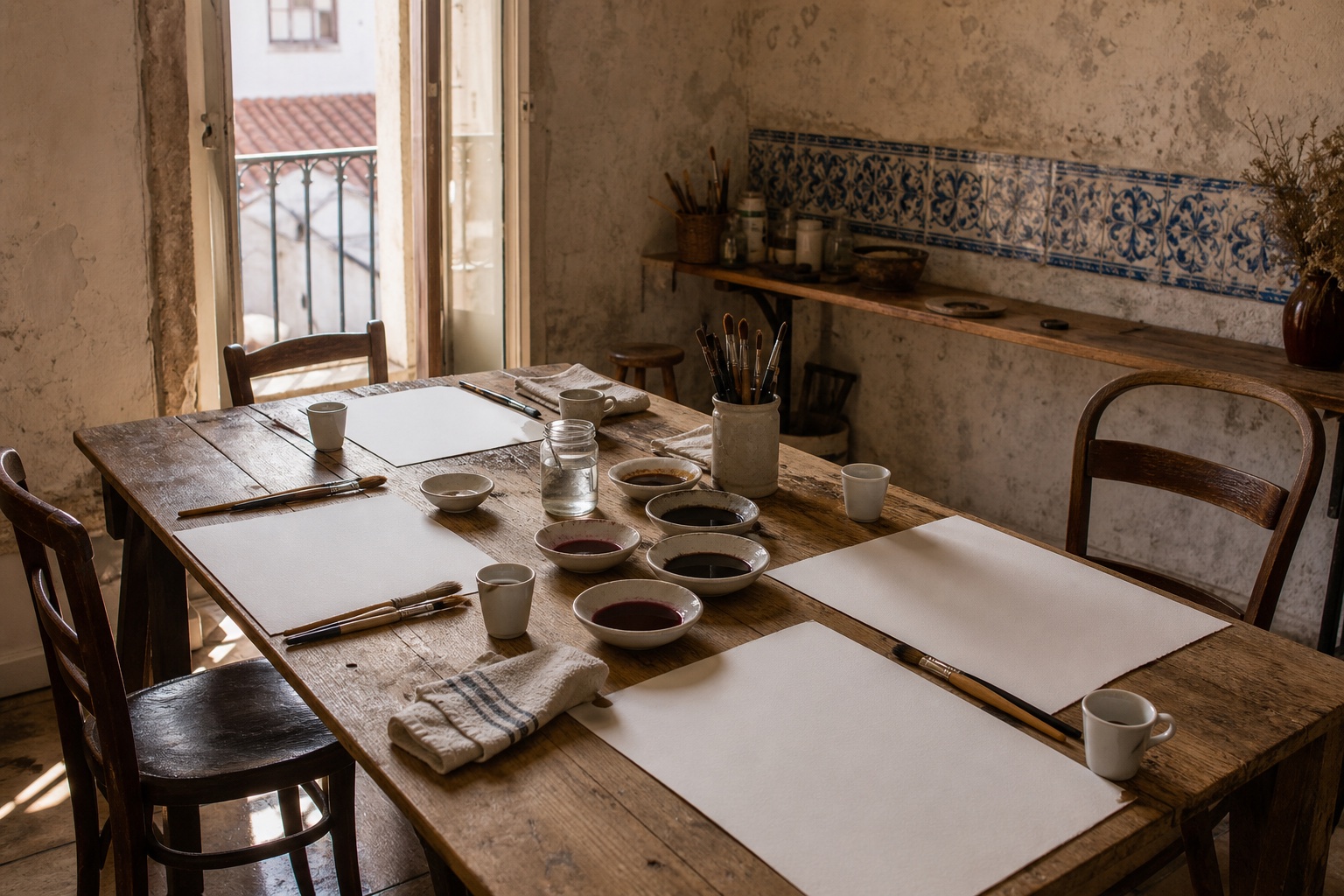
The honest collector answer is not “coffee lasts” and “wine fades.” Both are complex, non-standardised organic materials, and the finished object includes far more than the liquid in the cup: paper, ink, mixtures, concentration, layering, any fixative, framing and years of light exposure all matter. Rouslam Botiev uses coffee and red wine for different visual behaviour. You can enjoy that material story without pretending it carries the predictability of a tested commercial pigment.
What coffee and wine do differently on paper
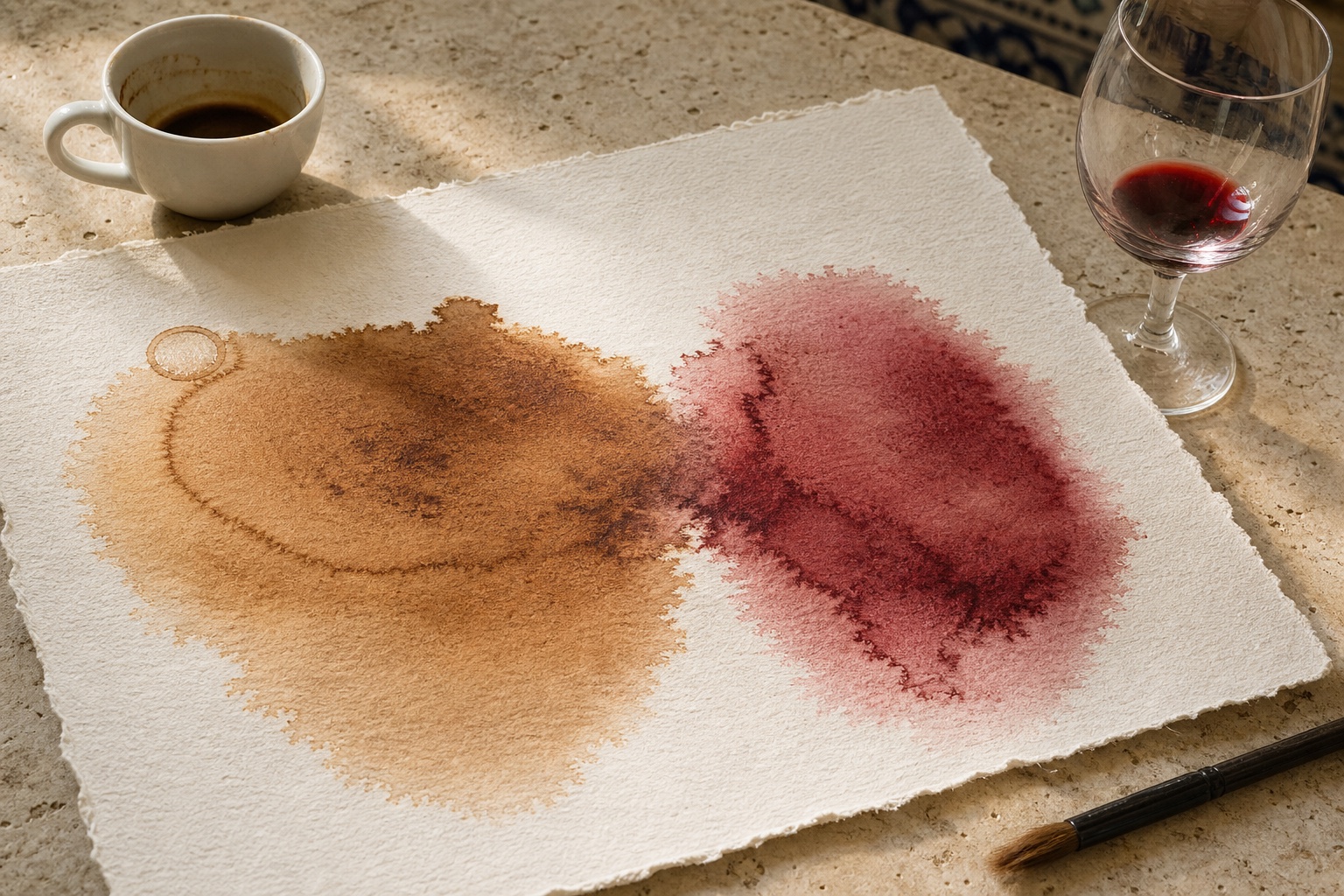
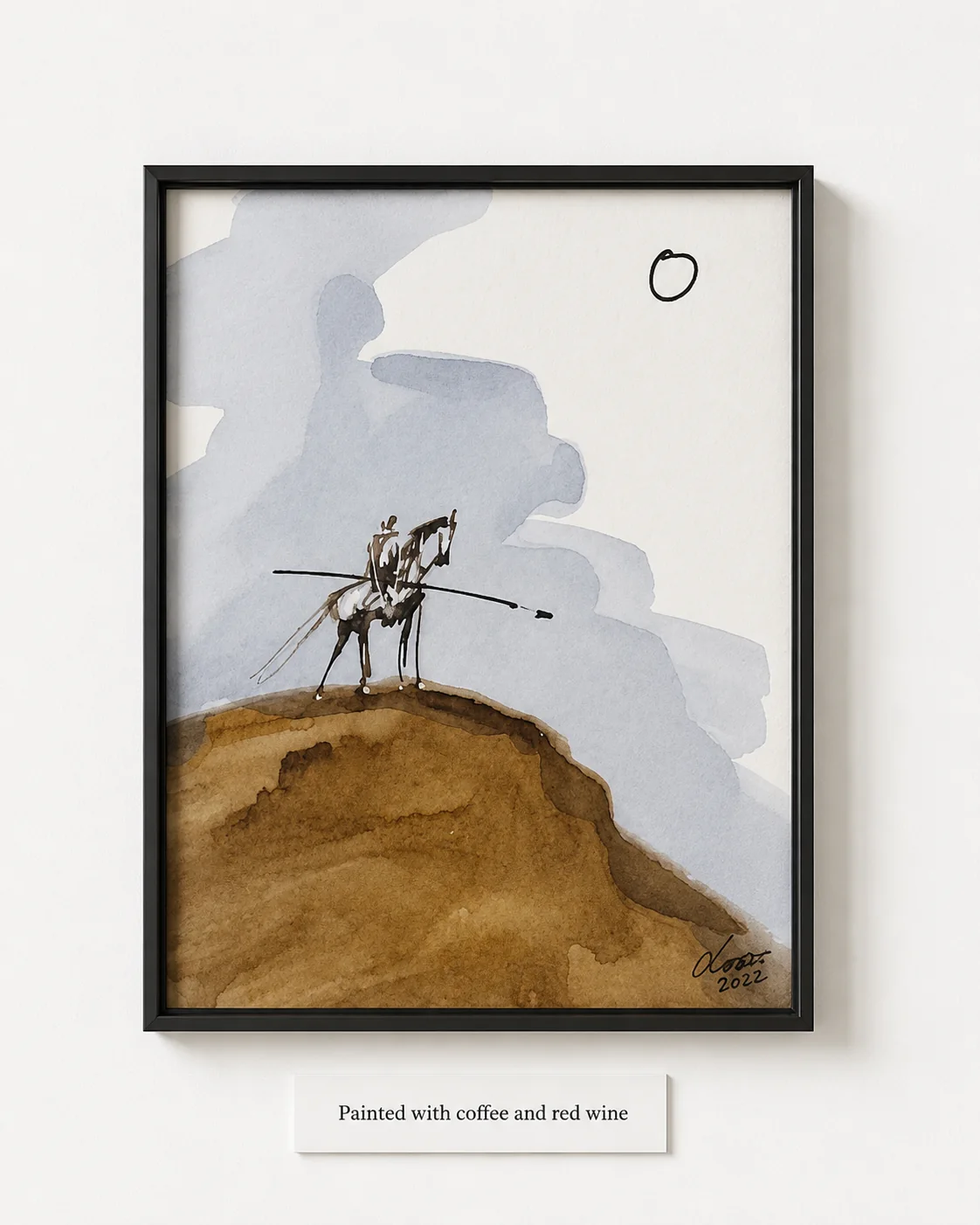
Coffee begins in a naturally restrained register. Concentrated coffee can make deep brown lines; dilution opens it into transparent tan and warm grey. It behaves like a single-colour wash, with darker deposits at overlaps and edges. As it dries, a wet mark generally becomes lighter and less glossy, so the artist has to judge the final relationship rather than the dramatic first stain. The result can feel architectural, smoky or intimate without needing a large colour range.
Red wine starts with a more conspicuous transformation. Fresh marks may show cooler violet, purple or ruby notes, then settle toward garnet, brick, russet and brown as liquid evaporates and the colourants react with oxygen, light and the chemistry of the support. That change is not an error hidden from the buyer; it is part of why painting with wine requires anticipation. It is also why a photograph taken while a passage is wet should never be used as the sole description of the finished colour.
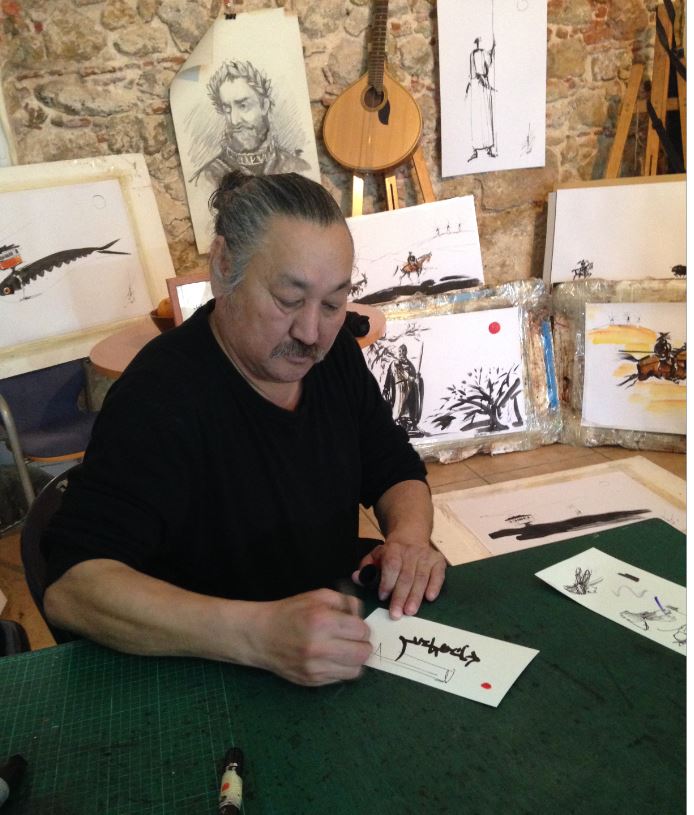
In Rouslam’s Tinta, Café e Vinho work, coffee and wine can appear alongside ink and unpainted paper. Each element has a different job: a dark line may hold structure, a pale wash may establish atmosphere, and the untouched sheet provides light. Do not assume that every brown passage is coffee or every reddish passage is wine from appearance alone. The artist’s materials record is the better source.
Think in risks and records, not permanence slogans
Conservation authorities describe light damage to paper and colourants as cumulative and irreversible. UV is damaging, but filtering UV does not stop all fading because visible light also supplies energy. Organic, dye-like colours can be especially light-sensitive. That makes “protected by UV glass” a useful risk reduction, not a promise that a work can live indefinitely opposite a sunny window.
There is no responsible universal lifespan for “a coffee painting” or “a wine painting.” Two sheets can differ in paper acidity, sizing, thickness, mixtures, application, treatment and display history. A fixative may alter handling or surface behaviour, but the word alone says little: product, method and compatibility matter. Likewise, “acid-free paper” is meaningful information about the support, not proof that every colour on it is lightfast.
| Variable | Why it matters | Useful collector question |
|---|---|---|
| Support | Paper composition and sizing affect absorption and ageing. | What paper or support was used? |
| Media | Ink, coffee, wine and added colour may respond differently. | Which materials are present in this work? |
| Treatment | A coating or fixative can change the surface and future conservation choices. | Was anything applied after painting? |
| Exposure | Brighter and longer light exposure increases cumulative damage. | How should this particular work be displayed? |
| Condition | A dated image creates a reference for noticing later change. | Can the invoice or certificate include a photograph? |
A conservative care plan for coffee and wine works
- Choose an interior wall without direct sun. Avoid a position where a moving sunbeam reaches the work for part of the day.
- Use a qualified framer. Ask for conservation-quality, reversible mounting, a spacer or window mount that keeps the image from touching the glazing, and glazing selected for the medium and room.
- Control all light, not only UV. Filters help, but curtains, sensible room lighting and periods away from display reduce total exposure.
- Keep the work away from radiators, fireplaces, cooking vapour, bathroom humidity, condensation and exterior walls known to become damp.
- Handle the sheet as little as possible. Hold documentation separately, and do not apply household cleaners, water, spray varnish or adhesive tape.
- Make a clear, colour-managed photograph when the work arrives, then inspect it occasionally in the same lighting. If you see mould, flaking, severe distortion or rapid change, consult a paper conservator rather than attempting a repair.
The goal is not to freeze an organic object outside time. It is to slow avoidable change and preserve evidence of its condition. Even conventional watercolours and inks are managed through light, environment and careful framing. Coffee and wine works deserve the same disciplined habits, with added caution because recipes are individual and long-term performance is not standardised.
Choose the visual relationship you want to live with
If your preference is quiet tonal unity, coffee-led work offers warm sepia, transparent layering and an immediate link to Lisbon’s everyday café ritual. If you are drawn to material change, wine introduces a stronger conversation between fresh colour and settled earth tones. A mixed coffee-and-wine work can hold both: structure and warmth, morning and evening, stability sought through careful construction and visible change acknowledged rather than denied.
Before choosing, view a current image of the dry work and, if possible, the object itself. Ask when it was made and whether the photograph accurately represents its present state. Read the medium line, dimensions and condition; ask what the certificate records; and decide whether the proposed display location respects a sensitive work on paper. Those questions are more valuable than demanding a number of guaranteed years that nobody can honestly calculate from a web listing.
Rouslam’s collector route is appropriate when material documentation matters to the purchase or when you are considering a larger work or commission. Describe the room, the available wall, the kind of imagery you respond to and your tolerance for the evolving character of organic colour. The commercial next step is then concrete: enquire about an actual work and its records, not about coffee or wine in the abstract.
Collect with context
Ask about the work, materials and record together
Use the collector enquiry for a current work or commission when medium, documentation and long-term care are part of your decision.
Explore the collector route →Frequently asked questions
Does a red-wine painting keep its original purple colour?
Do not assume it will. Wine marks commonly shift as they dry and may continue to change with light and ageing. Ask for a current photograph of the dry work and treat it as a light-sensitive work on paper.
Is coffee paint archival?
“Coffee” alone is not an archival specification. Performance depends on the coffee preparation, paper, other media, treatment, environment and exposure. Ask for the documented materials and use conservative paper-art care.
Is UV-protective glass enough?
No. It reduces ultraviolet exposure, but visible light can also cause irreversible change. Avoid direct sun, limit overall brightness and exposure time, and use appropriate conservation framing.
Can I clean a coffee or wine painting at home?
Do not put water, cleaning products or a new coating on the surface. Dust the outside of the frame carefully. For marks, mould, flaking or distortion, consult a qualified paper conservator.
Sources and verification
Sources support external facts; atelier details should be confirmed on the live pages linked in this guide.